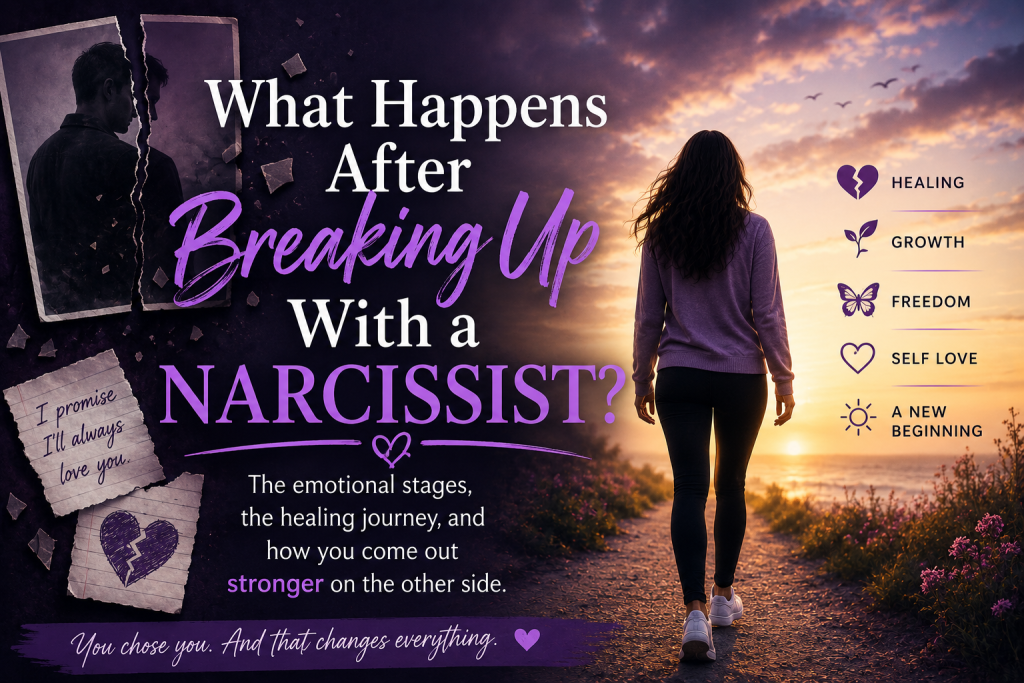
Once you’ve taken the decision to finally breakup with a narcissist, a lot may happen. When you’re in a relationship with a narcissist, it often doesn’t matter who initiated the breakup; the emotional aftermath is painful either way.
If you were the one who ended the relationship, be proud of yourself. It takes tremendous courage to walk away from someone who has been emotionally manipulative, abusive, or toxic. On the other hand, if the narcissist ended the relationship, remember that is not as great a loss as it may initially feel. Yes, being discarded can be incredibly painful, but how you choose to move forward afterward will have the greatest impact on your healing. At the end of the day, breakups are difficult regardless of who initiated them.
That said, this blog post focuses on the perspective of those who chose to end the relationship. In my next post, I’ll discuss the experience of those who were “discarded” by the narcissist.
So, What Happens After Breaking Up With A Narcissist?
1. A Sense of Relief
After breaking up with a narcissist, many people initially feel a sense of relief. You may think, Finally, I did it! Finally, you’re free from the emotional weight you’ve been carrying for so long. You may feel proud and empowered for having made the difficult decision to remove such a toxic person from your life.
Being in a relationship with someone who is emotionally manipulative or toxic can be incredibly draining. It consumes your time, energy, and emotional well-being. At first, the peace may even feel unfamiliar because you’ve become so accustomed to chaos. However, with time, that sense of peace begins to feel normal, and you realize just how exhausting the relationship truly was.
2. Confusion
Breaking up with a narcissist often leaves you feeling deeply confused. You may find yourself replaying countless moments from the relationship and wondering whether any of it was real.
“Did he really love me?”
“If he hated me, then why did he date me?”
“Why did he insult me?”
“How did he go from the loving, caring, and charming man to an abusive one?”
Even if you were completely certain about ending the relationship, it’s natural to begin questioning your decision afterward. Your mind may constantly replay both beautiful memories and the painful ones.
This confusion is often driven by cognitive dissonance; the psychological discomfort that occurs when two conflicting beliefs exist at the same time. On one hand, you remember the caring, affectionate, and charming person you fell in love with. On the other hand, you experienced someone who lied, manipulated, insulted, or emotionally abused you. Your brain struggles to reconcile these two seemingly incompatible realities.
As a result, it may feel as though you dated two completely different people; the kind, loving partner and the cruel, hurtful one. In psychology, this is often referred to as a Jekyll and Hyde pattern because the person’s behaviour appears to shift so dramatically that it feels as though two different personalities are involved.
This internal conflict often leads to rumination, where you repeatedly replay conversations, arguments, and memories in an attempt to understand what happened. You search for an explanation that will finally make everything make sense, but genuine closure rarely comes from replaying the relationship over and over.
3. Your Heart Will Ache
This is often one of the most painful stages.
After breaking up with a narcissist, you may find yourself slowly starting to miss him. However, the grief can feel different from the end of many other relationships. Instead of simply missing a former partner, it may feel as though a part of you is missing. There can be an overwhelming emptiness; a painful void that convinces you that the only thing that will make it disappear is having him back in your life.
This is often the result of a trauma bond, an intense emotional attachment that can develop in relationship marked by cycles of affection and emotional harm. During the relationship, periods of love, kindness, and validation were often followed by criticism, manipulation, or emotional withdrawal. The unpredictable cycle, known as intermittent reinforcement, can strengthen emotional attachment, making it especially difficult to let go even after recognizing that the relationship was unhealthy.
As a result, your mind may begin replaying only the good memories. You may find yourself reminiscing about the happy moments while minimizing or temporarily forgetting the hurtful ones. You may even imagine that one day he will contact you, sincerely apologize for everything he put you through, and finally become the person you always hoped he would be.
This is often when regret begins to creep in, even though deep down, you know that ending the relationship was the right decision. It is an incredibly confusing feeling because your heart longs for someone your mind knows was not good for you.
I honestly don’t know hot to put that feeling into words. It feels like grieving someone who is still alive while simultaneously grieving the future you thought you were going to have together. It is one of the most painful emotional experiences I have ever endured.
4. You Feel Betrayed
You gave your all to the relationship, yet you were treated poorly in return. As you replay certain memories while lying in bed crying, you may feel deeply betrayed. The person you trusted promised to love you unconditionally and to be your greatest source of support. Instead, you were taken for granted and, at times, may have felt as though your kindness and compassion were used to meet his emotional needs.
The sense of betrayal can be incredibly painful because it comes from someone you trusted. In psychology, this is sometimes referred to as betrayal trauma, where the emotional pain is intensified because the harm was caused by someone with whom you shared a close emotional bond.
You may even feel ashamed for giving him a chance or for staying longer than you wish you had. However, trusting someone is not a character flaw. The responsibility for mistreating you belongs to the person who chose to do so.
You might also feel the urge to contact him and tell him how much he hurt you. While those feelings are completely understandable, reaching out rarely provides the closure people hope for. Instead, it often reopens old wounds and can pull you back into the same unhealthy dynamic. Real closure comes from accepting that not everyone is willing or able to take accountability for the pain they caused.
5. You Feel Damaged
After breaking up with a narcissist, you may feel damaged. You may realize that you are no longer the same person you were before entering the relationship. You may feel emotionally exhausted, question your judgment, or even struggle to recognize yourself. You may look back at certain behaviours and wonder, “Why did I tolerate that?” Or “Why did I become someone I don’t recognize?”.
Many people also experience hypervigilance, where they become overly alert to potential danger, criticism, or manipulation because their nervous system has become accustomed to living in survival mode.
Personally, I experienced symptoms that were later diagnosed as CPTSD. Certain songs we used to listen to or dance to would instantly trigger an avalanche of memories and emotions. At one point, I needed antidepressants to help manage the anxiety that followed the relationship.
Although I felt more emotionally damaged after the breakup than I did before entering the relationship, I eventually realized something important: I was not permanently broken. I had been deeply affected by an unhealthy relationship, but healing was possible. With time, support, and self-work, I slowly began to recognize myself again.
6. You Become Angry
As time passes, your sadness may gradually turn into anger. More often than not, that anger is directed at yourself rather than at the other person.
You may replay certain situations over and over, wondering how you could have responded differently. You might think, “Why didn’t I leave after the first insult?” or “Why did I keep making excuses for his behaviour?”
Looking back, it’s easy to judge yourself with the knowledge you have today. However, remember that you made those decisions with the information, hope, and emotional circumstances you had at the time.
Instead of allowing self-blame to consume you, try practicing self-compassion. The same grace, patience, and understanding that you extended to someone else’s repeated mistakes are qualities you now deserve to extend to yourself. Yes, perhaps you could have left sooner. Perhaps you overlooked red flags or justified behaviour that should never have been tolerated. But those choices do not define your worth.
Your empathy was never the problem. The problem was that it was given to someone who repeatedly chose not to value it. Now it is time to offer that same empathy and compassion to yourself as you continue to heal.
7. You Become Grateful
As time passes and you begin to realize that the damage is not permanent, something unexpected starts to happen; you become grateful that you left.
You no longer mourn only the time you invested in the relationship. Instead, you become grateful that you no longer have to spend another day living in that unhealthy dynamic. Although the relationship may have left some emotional scars, it also taught you valuable lessons about boundaries, self-worth, and the kind of love you deserve.
This stage reflects what psychologists often refer to as post-traumatic growth; the positive psychological changes that can occur after enduring significant adversity. While you would never choose to experience that pain again, you begin to recognize the strength, wisdom, and resilience you gained from surviving it.
You become grateful that you eventually saw the relationship for what it truly was and found the courage to walk away. Most importantly, you realize that your future is no longer dependent on someone who repeatedly hurt you. You are finally free to build the life you want without allowing someone else to continually diminish your peace.
8. You Question Yourself
After breaking up with the narcissist and eventually falling out love, you start questioning yourself.
“How did I fall in love with that person in the first place?”
“Why did I ignore the red flags?”
“Why did I stay after he insulted me?”
“Why did I stay after he compared me to his ex or to another woman?”
These questions can be painful because they force you to confront decisions you wish you had made differently.
I’ve been that person. I was deeply ashamed of myself for staying, even though I had many opportunities to leave. At the time, I genuinely believed that what I was experiencing was normal. I thought being criticized, insulted, or constantly made to feel “less than” was simply part of loving someone. Somewhere along the way, I had also convinced myself that no other man would ever love me.
Looking back, I now realize that none of those beliefs were true.
Through healing and self-reflection, I recognized that I had unresolved childhood wounds that distorted my understanding of what a healthy relationship should look like. Those experiences had normalized unhealthy behaviour and led me to believe that I had to tolerate mistreatment, work harder to earn love, and constantly please others in order to feel worthy.
This realization was painful, but it was also freeing.
If you recognize yourself in these words, know that healing begins with becoming aware of these patterns. People-pleasing may feel like kindness, but when it comes at the expense of your own well-being, it becomes self-neglect. Healthy relationship do not require you to abandon your boundaries to keep someone else happy.
You are allowed to say no. You are allowed to have standards. You are allowed to leave relationship that repeatedly hurt you. Other people’s happiness is not your responsibility, but protecting your own peace is.
Final Thoughts
Breaking up with a narcissist is not simply the end of a relationship; it is the beginning of rebuilding yourself.
You may experience relief, confusion, grief, betrayal, anger, gratitude, and self-reflection, sometimes all in the same day. Healing is rarely linear. Some days, you’ll feel as though you’ve completely moved on, while on others, a song, a place, or a memory may bring back emotions you thought were long gone. That doesn’t mean you’re moving backward. It simply means you’re healing.
Most importantly, remember that leaving a narcissistic relationship does not define your future. The way you choose to heal does.
As painful as this chapter may have been, it also taught you valuable lessons about boundaries, self-worth, and the kind of love you deserve. Those lessons will help you recognize healthier relationships and protect your peace moving forward.
If there’s one thing I hope you take away from this article, it’s this: never regret choosing yourself.
Walking away from someone who repeatedly hurt you was not a failure; it was one of the greatest acts of self-respect you could have shown yourself. One day, you’ll look back and realize that what once felt like the end of your world was actually the beginning of a healthier, happier, and more authentic version of yourself.
Until next time,
Yours truly,
– Melody 💜
Your life. Your rules 💜👑